
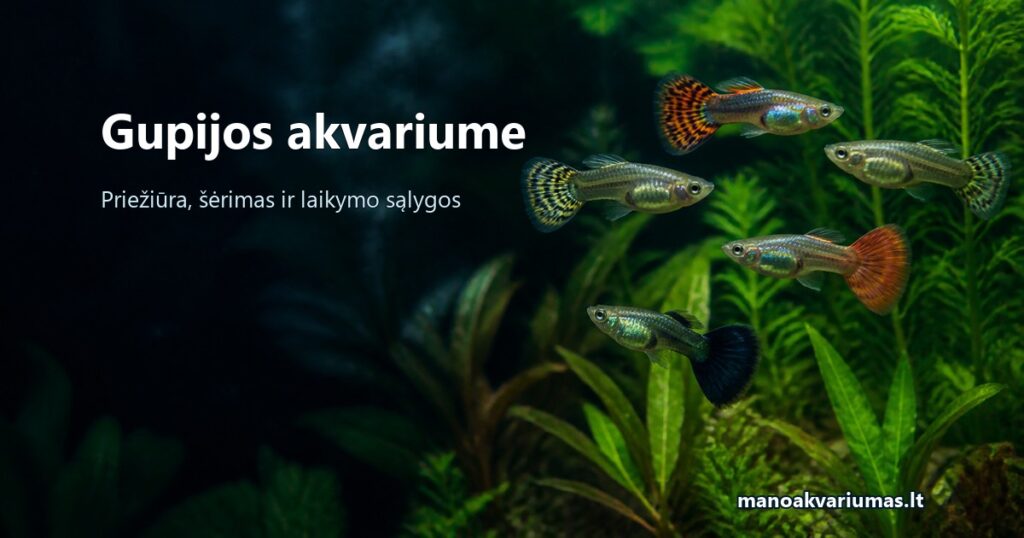
Guppies (Poecilia reticulata) are often chosen for a first aquarium. They are active, colourful and adapt well to a range of conditions, but ‘undemanding’ should not mean skipping aquarium cycling, water tests or regular maintenance.
What are guppies, and who are they suitable for?
Guppies' natural distribution is associated with northern South America and the Caribbean. Many selectively bred forms are kept in aquariums, differing in colour, fin shape and sometimes sensitivity to environmental changes.
Guppies can be a good choice for beginners if the aquarium is already cycled, the keeper is ready to monitor water quality and potential growth in the number of young has been considered beforehand.
What kind of aquarium do guppies need?
Space and group size
Guppies are social, active fish. FishBase aquarium guidance mentions a group of at least five individuals and a tank at least 60 cm long. This is a starting point, not a universal formula: suitable numbers depend on tank volume, shape, filtration, plants and other inhabitants.
If males and females are kept together, breeding must be anticipated. Guppies are livebearers, and females can produce young repeatedly. Dense plants and hiding places improve the fry's chances of survival, so the population may grow faster than expected.
Filtration, temperature and maintenance routine
The filter must run continuously and suit the aquarium's biological load. The RSPCA gives guppies a temperature range of 22–28 °C, but avoiding sudden fluctuations and considering the particular group's origins and other species' needs are most important. Water parameters must be checked with tests, not judged merely by clear-looking water.
The frequency and amount of partial water changes depend on fish numbers, feeding, plants and test results. Filter media should not be rinsed under chlorinated tap water, as this can harm the beneficial bacterial colony.
Feeding and daily observation
Guppies eat a varied diet. In practice, a complete food suited to their size is convenient, with dietary additions according to the manufacturer's and specialist's recommendations. Give an amount the fish eat within a short time and remove uneaten food. Overfeeding quickly increases the biological load.
Observe appetite, swimming, breathing, fins and whether any fish is constantly chased every day. Sudden lethargy, clamped fins, frequent surface gathering or unusual hiding are first a signal to check temperature, the filter, ammonia and nitrite. This is not a diagnosis; if the condition worsens, consult a specialist or veterinarian with knowledge of fish health.
Which fish can be kept with guppies?
A species name alone is not enough. Compare adult size, water requirements, activity, group size and behaviour. Guppies' long fins may attract fin-nippers, while larger species may see guppies as prey.
For keeping them with a betta, read the separate guide ‘Guppies and a betta in one aquarium’. A backup separation plan is important because even individuals of the same species differ in temperament.
When is it worth consulting a specialist?
Seek help before increasing fish numbers, replacing a filter, combining several species or when water quality fluctuates repeatedly. For a first aquarium, start with our guide ‘Aquarium fish for beginners’ and general aquarium maintenance overview.
Need an assessment of your aquarium conditions?
If you are in Vilnius, send a photo of the aquarium, its volume, a list of inhabitants and a description of your equipment. Contact us for advice or maintenance.
Sources
- FishBase: Poecilia reticulata – distribution, size, biology and care guidance.
- RSPCA: Choosing an aquarium for pet fish – aquarium cycling, temperature and water quality.
- Merck Veterinary Manual: Providing a Home for Fish – biological filtration and water testing.