
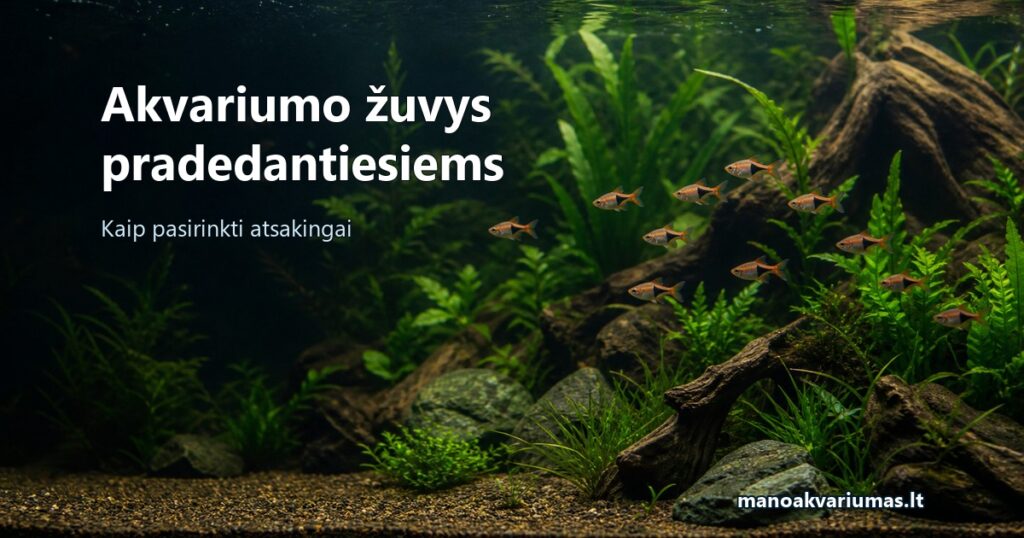
Your first aquarium fish as a beginner should be chosen only once the tank volume, equipment and water parameters are known. An attractive fish in a shop will not necessarily suit your system, and even an ‘undemanding’ species depends on stable water quality.
Choose suitable conditions before choosing a fish
Aquarium size and equipment
Record the actual water volume, filter model, temperature and planned maintenance routine. Judge a fish's size by its adult size. A small juvenile may grow several times larger, and group-living species need space for the entire group, not just one fish.
Essential equipment includes a filter suited to the aquarium, an appropriate thermostatic heater for tropical species, lighting, a secure lid and water tests. Plants and hiding places are more than decoration: they help define territories and give fish somewhere to retreat.
How much time can you devote to maintenance?
Fish, temperature and equipment need daily observation. Regular tasks include partial water changes, glass cleaning, checking filter flow and measuring water parameters. If you travel frequently, plan feeding in advance and arrange a responsible person who can notice an equipment failure.
When can you add the first fish?
The RSPCA recommends cycling a new aquarium without fish. The filter needs time for bacteria that process ammonia and nitrite to establish themselves. The cycle is assessed using tests: fish are introduced only after ammonia and nitrite have risen and both have returned below the detection limit. The calendar is not a reliable criterion: the process may take several weeks.
The Merck Veterinary Manual stresses that too many fish added at once can exceed a biological filter's capacity. Introduce inhabitants gradually and monitor water quality after each stage.
How should you assess compatibility between fish?
Check more than temperature. At least six factors matter:
- adult fish size and predation risk;
- whether the species is kept in a group, a pair or alone;
- territorial behaviour and activity levels;
- overlapping temperature, hardness and pH requirements;
- swimming zone and need for hiding places;
- feeding behaviour and whether every fish can get food.
A seller saying ‘they should get along’ is not a guarantee. Have a backup plan to separate fish, especially when combining territorial fish or long-finned varieties.
Guppies or a betta: where should you start?
These two examples help compare different needs, but are not a general list of suitable fish for every aquarium.
- Guppies: before choosing them, consider their activity, the composition of the group and potential population growth. Read more in our guppy care guide.
- Betta: plan its space first and assess tankmates cautiously. Read more in our betta aquarium and care guide.
If you want to keep both species together, separately review the compatibility risks for guppies and bettas. For a beginner, it is easier to plan one clear setup first than to buy several appealing species at once.
Group-living, territorial and bottom-dwelling fish
A group-living species should not be bought singly simply to save space. Territorial species need clear boundaries and hiding places. Bottom-dwelling fish do not automatically fill ‘empty space’: they need suitable substrate, floor area, feeding and any required group.
Guppies are active livebearing fish whose population can grow quickly. Betta fish is territorial and requires more cautious tankmate selection. Both examples show why ‘beginner fish’ cannot be reduced to one simple list.
Common mistakes when choosing fish
- buying fish on the same day as the aquarium;
- considering juvenile rather than adult size;
- ignoring the required group size;
- adding too many inhabitants at once;
- trusting clear water without testing ammonia and nitrite;
- having no backup plan for aggression or incompatibility.
What should you ask the seller or specialist?
Write down the species' scientific name, adult size, recommended group, temperature and water parameter ranges, diet, behaviour and potential tankmates. Ask whether the fish was bred locally, the water in which it has been kept and whether any health problems have been noticed in the sales system.
Read about everyday tasks in our aquarium maintenance guide, and find the setup stages on our ‘Aquarium installation in Vilnius’ page.
Planning your first aquarium?
Send a photo of the intended location, its dimensions and a few words about the fish you like. Get in touch – we will help you plan a realistic aquarium setup in Vilnius.
Sources
- RSPCA: Choosing an aquarium for pet fish – fishless cycling, water testing and temperature.
- Merck Veterinary Manual: Providing a Home for Fish – biological bacteria, chlorine and gradual stocking.
- Merck Veterinary Manual: Management of Aquarium Fish – new tank syndrome and biological filter maturity.